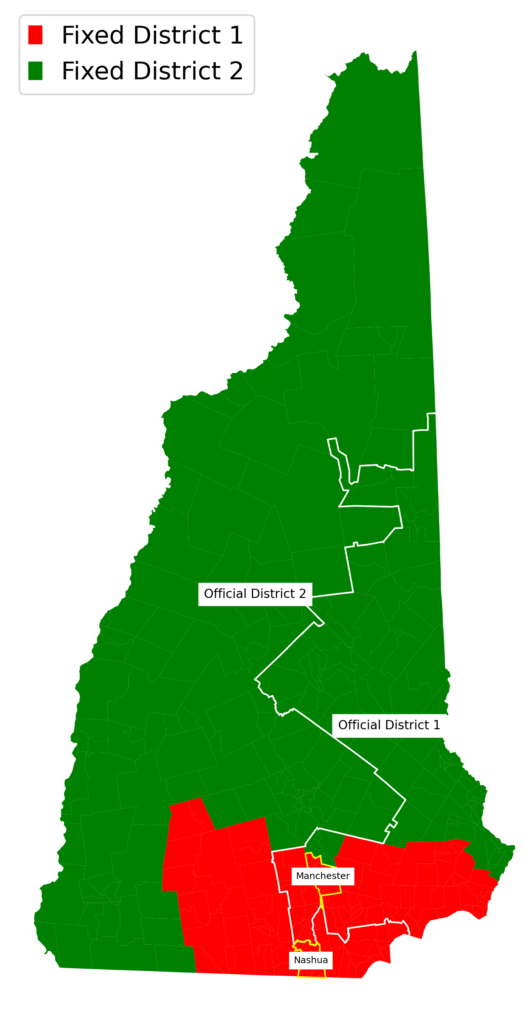
Continuing my series about reversing gerrymandering and creating fair congressional districts – last Wednesday I fixed New Hampshire. Today, let’s take a deeper look at the Granite State:
One thing you might have noticed in last Wednesday’s map was a weird protrusion sticking out like a wang on the southeastern part of the state. That’s because, as we saw earlier this month with Florida, the geographic shapefile included incorrect coastlines – it included the Atlantic Ocean between the New Hampshire mainland and tiny White Island. In today’s map, I fixed that shapefile.
If you look at the southern part of the state, you’ll see the other change – one that shows an important insight that we will see over and over again as we go through states.
I have labeled in yellow borders the two largest cities in New Hampshire. Manchester holds 8 percent of the state’s total population, and Nashua holds another 7 percent. In the state’s official Congressional districts (border shown by the white line), Manchester and Nashua are in separate districts. In my fair districts, both are in District 1 (red).
It makes sense that I would put both in the same district: my organizing principle is to keep similar areas together. Manchester and Nashua have more in common with one another than they do with the rest of the state, which is mostly rural.
We’ll see this over and over again, with increasing levels of ridiculousness, as we look at bigger and bigger states: government-approved districts split urban areas – deliberately keeping people who live in cities from being represented.