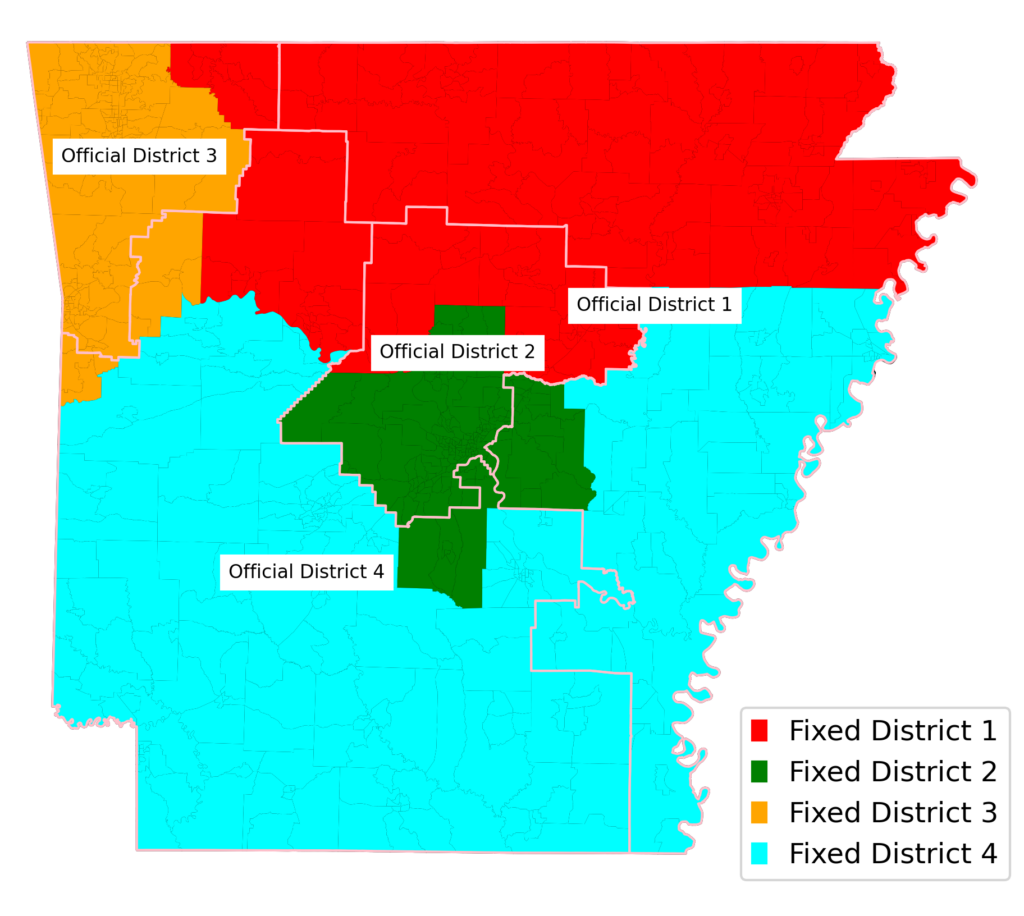
And so we arrive at the first state with four Congressional districts: Arkansas. The map is below. My attempt at fair districts are show by colors, and the official districts are divided by pink lines with labels. A fourth district requires a fourth color: I chose cyan (light blue). I love this color scheme by the way.
My approach has always been to start in the middle of the largest city (in the case of Arkansas, Little Rock) and move outwards, adding counties or census tracts one at a time until the district’s population gets close to (total state population / number of districts) – in the case of Arkansas, until each district has approximately 750,000 people. Normally I would name the place where I started “District 1,” but in this case, I went with District 2 to match the fact that the official district of Little Rock is 2.
When District 2 had enough people, I moved on to the next largest urban area: northwest Arkansas, home to the cities of Bentonville, Fayetteville, and Fort Smith, which I called District 3. The next largest urban area is Jonesboro in the northeast, which I filled up and called District 1. And then the remainder of the state became District 4.
The official districts to my hopefully-fair districts. Fort Smith is officially in District 4, while I had it in District 3 with the other Northwest Arkansas cities. I was expecting the official district boundaries to split up Little Rock, so I was surprised that they didn’t. Little Rock is entirely within official District 2, as well as my District 2.
What that means is that Arkansas is fairly districted. That obviously won’t be the case for every state.
At the end of my previous post, I asked a question: what’s worse than being burned at the stake?
This.
On May 8, 1916, Lucy Fryer was found dead in her Robinson, Texas home. She had been killed by blunt force trauma to the head. Suspicion immediately fell on Jesse Washington, a 17-year-old illiterate black boy with an intellectual disability who the Fryers hired as a farmhand. County police arrested Washington the same night and interrogated him without a lawyer present. Washington confessed and signed a statement admitting to the murder.
Washington’s trial was on May 15th. More than two thousand local residents (nearly all white) attended, spilling out of the courthouse onto the adjacent streets. The trial lasted less than an hour. The jury deliberated for only four minutes before returning a guilty verdict. Sentencing was scheduled for the next day – but never got to that point. As sheriff’s deputies approached Washington to return him to county jail, the crowd surged forward, grabbed Washington, and dragged him out the front door. Washington tried to fight back, but was quickly overpowered and beaten. The crowd stripped off all his clothing and someone attached a chain to his neck.
The crowd used the chain to drag him by the neck all the way from the courthouse to Waco city hall, where another group had already prepared a bonfire next to a tree. At some point he was castrated. Jesse Washington was already beaten and bloody when he was doused with oil and hoisted on to a tree branch above the fire.
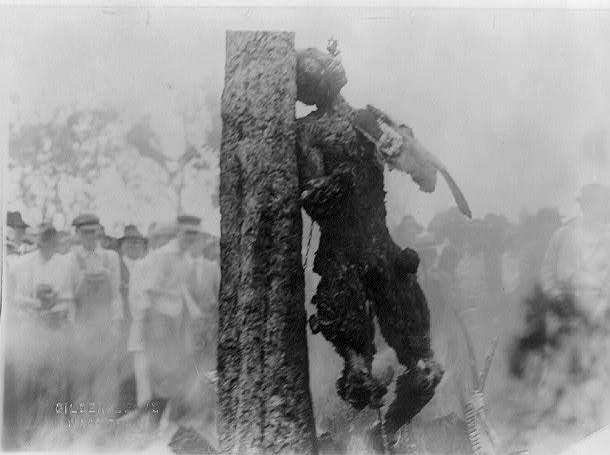
Here’s where it gets hard to read. He was repeatedly lowered into the fire, then raised again. Members of the crowd took turns removing Washington’s fingers, toes, and teeth – some of which were sold as souvenirs weeks after the lynching. His body was raised and lowered over the flames for more than two hours before he finally died of smoke inhalation and/or burning. Click on the moose photo below to see the result.
This is a moose. Click on it to see what happened to Jesse Washington.
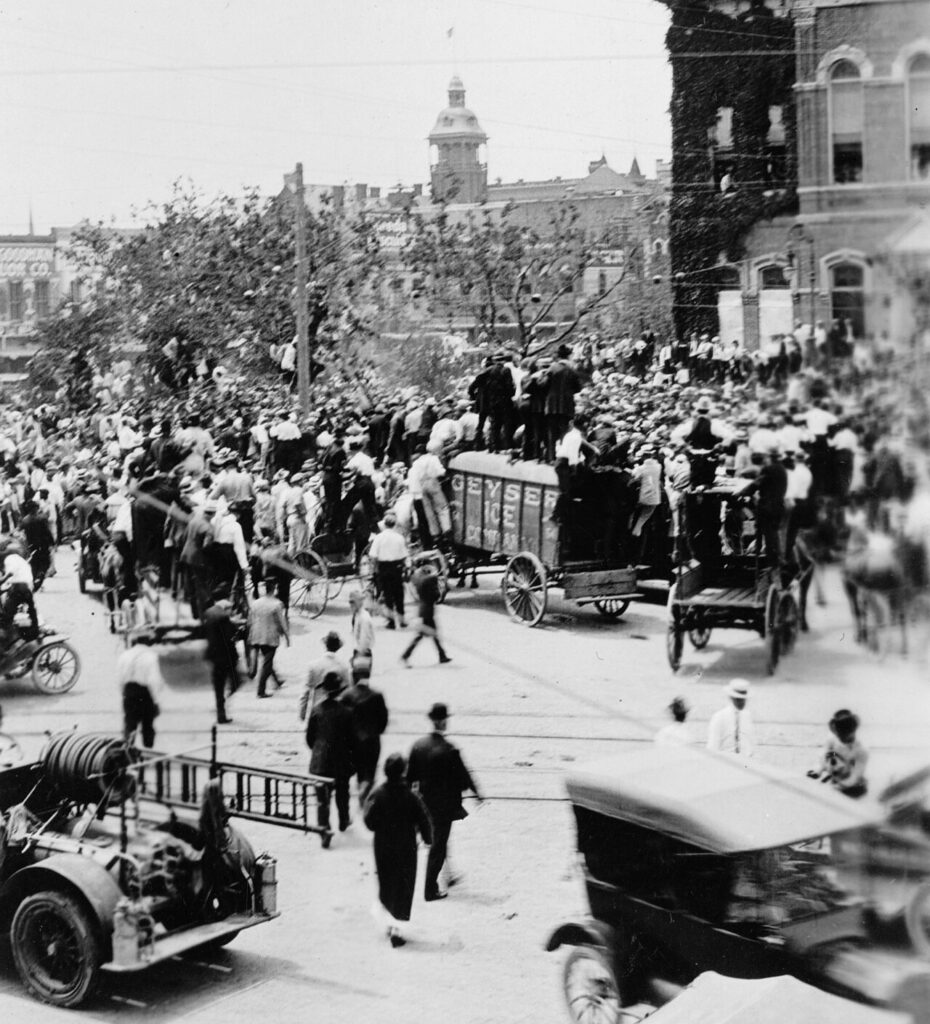
As the hours of Jesse Washington’s suffering passed, the crowd grew. The relatively new invention of the telephone helped spread the word as people called their friends to join. At the peak, the crowd was estimated at 10,000 people – in a city of only 30,000. Children were let out of school early to join the crowd. The photo below shows the assembled crowd – you can see the tree but Washington is hidden behind the crowd.
Three things made Jesse Washington’s lynching distinct from the thousands of other lynchings that occurred all over the American South. First, its sheer brutality, which earned the incident the nickname “The Waco Horror.” Second, the fact that Waco at the time was seen as a progressive city, home to several colleges and anti-lynching activists. If such an evil act could happen in Waco, it could happen anywhere.
Third, the entire process was documented in a way that few other lynchings were. Fred Gildersleeve, a professional photographer living in Waco, arrived at the bonfire just as Jesse Washington did. Gildersleeve recorded the whole process, and took the two photos that I have used in this post. Gildersleeve’s photos were used in postcards that were sent all over the world. The postcards made him a rich man.
Let’s address the moose in the room: did Jesse Washington kill Lucy Fryer?
I don’t care.
We have a legal system for a reason, and in this case, the legal system didn’t get a chance to rule. The people of Waco took that away from us.
So, does this mean that all lynching victims were found guilty of crimes – or even accused of crimes? As we’ll see in the next post – far from it.
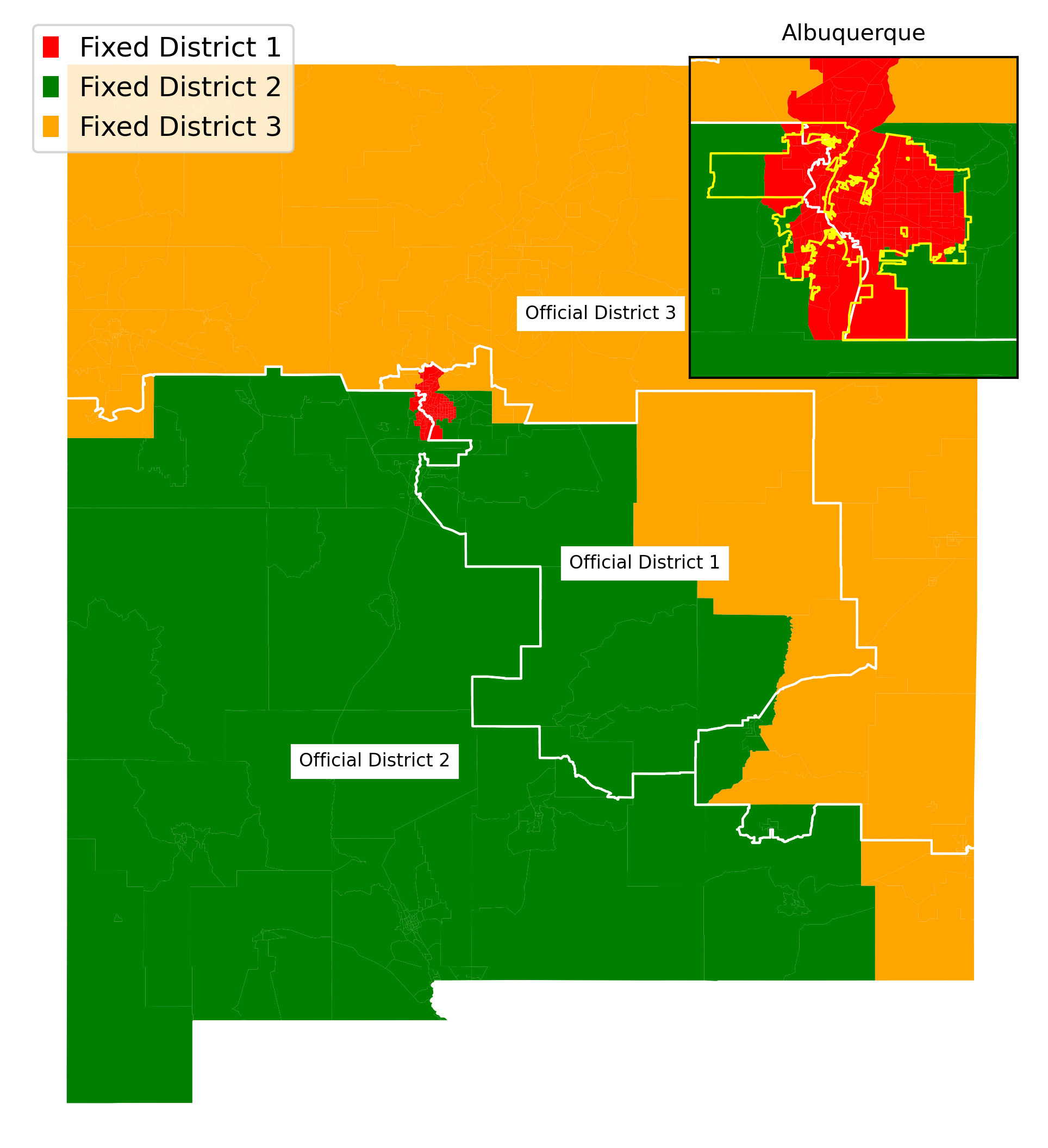
The other state with three Congressional districts is New Mexico. The map is below. My attempt at fair districts are show by colors: District 1 is red, District 2 is green, and District 3 is orange. The borders between The inset at the top right shows the city of Albuquerue, home to 26 percent of New Mexicans. The borders of the city of Albuquerque are shown in yellow.
Suggested new Congressional Districts for Nebraska
Look at the borders of the city of Albuquerque. My attempting-to-be-fair districts keep all of Albuquerque in District 1. The actual congressional districts in New Mexico divide Albuquerque down the middle between District 1 and District 2. Yes, we’ll see that again and again and again as we move to bigger and bigger states.
The World Cup of Men’s Soccerfootball, currently going on in the United States and Canada and Mexico, has given us so many great stories. One of the most fun has been the bond between the Algerian men’s national team and the citizens of Lawrence, Kansas, where their training base is. Lawrence is a college town, home to University of Kansas. It’s a dot of progressivism in an extremely conservative state, and therefore welcoming to all. The welcome has gone so far that the University of Kansas marching band learned the Algerian national anthem and played it at the team’s training session:
And what a national anthem it is!
The best introduction to the world’s most badass national anthem is just to hear it and see the lyrics in real time. Watch this video, and make sure to stay until 27 seconds in, when the lyrics start:
And here are those lyrics, side by side, in both transliterated Arabic (written in Latin letters) and in English translation:
We swear by the lightning that destroys, By the streams of generous blood being shed, We swear by the lightning that destroys, By the streams of generous blood being shed, By the bright flags that wave, Flying proudly on the high mountains That we are in revolt, whether to live or to die, We are determined that Algeria should live, Bear witness! Bear witness! Bear witness!
The story of its creation is even more badass. Moufdi Zakaria, the independence hero of Algeria (in the same way that George Washington is the independence hero of the United States), wrote the lyrics in his own blood on the walls of the French Serkaji-Barberousse Prison in Algeirs, where he was being tortured.
So, watch the Algeria vs Argentina game tonight at 9 PM ET — but be sure to tune in at 8:55 PM ET to hear the world’s most badass national anthem.
Bonus content: As with most national anthems, people usually sing only the first verse. But the lyrics to the third verse are worth reading as a diss track to colonial overlords France:
Ya Firansa, qad mada waqtu l-‘itab Wa-tawaynahu kama yutwa l-kitab Ya Firansa, qad mada waqtu l-‘itab Wa-tawaynahu kama yutwa l-kitab Ya Firansa ‘inna dha yawmu l-hisab Fa-sta’iddi wa-khudhi minna l-jawab ‘Inna fi thawratina faslu l-khitab Wa-‘aqadna al-‘azma ‘an tahya l-Jaza’ir Fa-shhadu! Fa-shhadu! Fa-shhadu!
O France, the time of reproof is over And we have closed it as a book is closed; O France, the time of reproof is over And we have closed it as a book is closed; O France, this is the day of reckoning So prepare to receive from us our answer! In our revolution is the end of empty talk; We are determined that Algeria should live, Bear witness! Bear witness! Bear witness!
Southern trees bear a strange fruit Blood on the leaves and blood at the root Black bodies swingin’ in the Southern breeze Strange fruit hangin’ from the poplar trees
Pastoral scene of the gallant South The bulgin’ eyes and the twisted mouth Scent of magnolias sweet and fresh Then the sudden smell of burnin’ flesh
Here is a fruit for the crows to pluck For the rain to gather, for the wind to suck For the sun to rot, for the tree to drop Here is a strange and bitter crop
Abel Meeropol, “Strange Fruit,” 1939
I’m proud to have lived a life that has given me a reputation as a kind and caring person. This is not a kind or caring post. It’s the first in a series of posts that will be neither kind nor caring. Welcome to a series of posts about lynching.
In 1939, songwriter Abel Meeropol wrote the poem Strange Fruit, printed above – a haunting poem made even more famous by Billie Holiday’s musical version. Take a minute to absorb her version: a powerful interpretation of an already powerful poem. And keep it in mind as you read on.
What is Billie Holiday’s song, and Abel Meeropol’s poem that inspired it, about? Lynching – an illegal ceremonial public execution conducted by a group of people with the goal of intimidating others into compliance. The “strange fruit” is a human being hanging from a tree.
What makes the poem so powerful is that it describes the horrific aftermath of a horrific crime. Black bodies swinging in the southern breeze, blood on the leaves, bulging eyes and twisted mouth. Hanging was by far the most common method of lynching – but as we will see in future posts, far from the only method.
A lynching was not just a murder – it was an organized system of terror. There are examples from all over the world and throughout all time, but what we will focus on here is lynching as practiced in the southern United States. The perpetrators were almost always white. The victims were almost always black – but not exclusively, as we will see in future posts. The victims were men, women, and even children. The perpetrators were men, women, and even children.
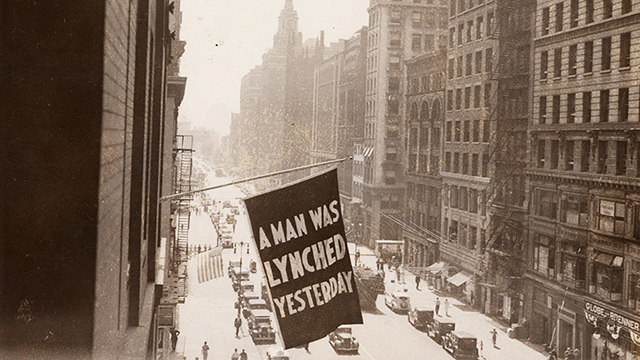
The flag flown outside NAACP headquarters on Fifth Avenue in Manhattan after lynchings between 1936 and 1938
Following emancipation, formerly enslaved people gained legal freedom, citizenship, and, at least briefly, political power. For many white Southerners who had built their identity and social position on slavery, these changes represented a direct challenge to the racial hierarchy that had governed Southern life for generations. Violence became one of the tools used to restore that hierarchy.
Lynchings frequently occurred when Black individuals challenged social norms, achieved economic success, attempted to vote, competed with white businesses, or were perceived as threatening the racial order in some way. The specific accusation often mattered less than the message being sent. That message was directed not at the victim (who was, after all, now dead) but at the entire community: keep quiet, or you’re next.
Between the end of the Civil War and the mid-1960s, thousands of people were victims of lynching. The exact number is hard to pinpoint because not every lynching was reported, and because of varying definitions of what constitutes a lynching. The best-known count comes from Tuskegee University, which identified 4,743 victims. You can explore the history for yourself from the American Lynching dataset, or from this excellent mapping tool from Monroe Work Today.
And I wouldn’t be me if I weren’t willing to dig in to the data.
But that’s not what matters now. What matters now is historical fact and the stories that go along with it. So here is a question to think about for the next post in this series: