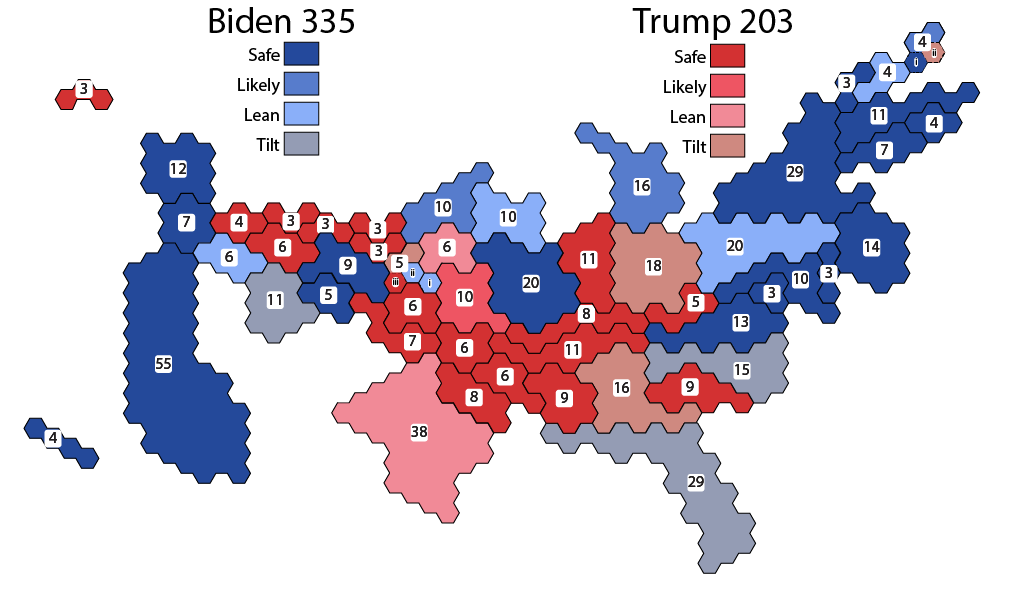
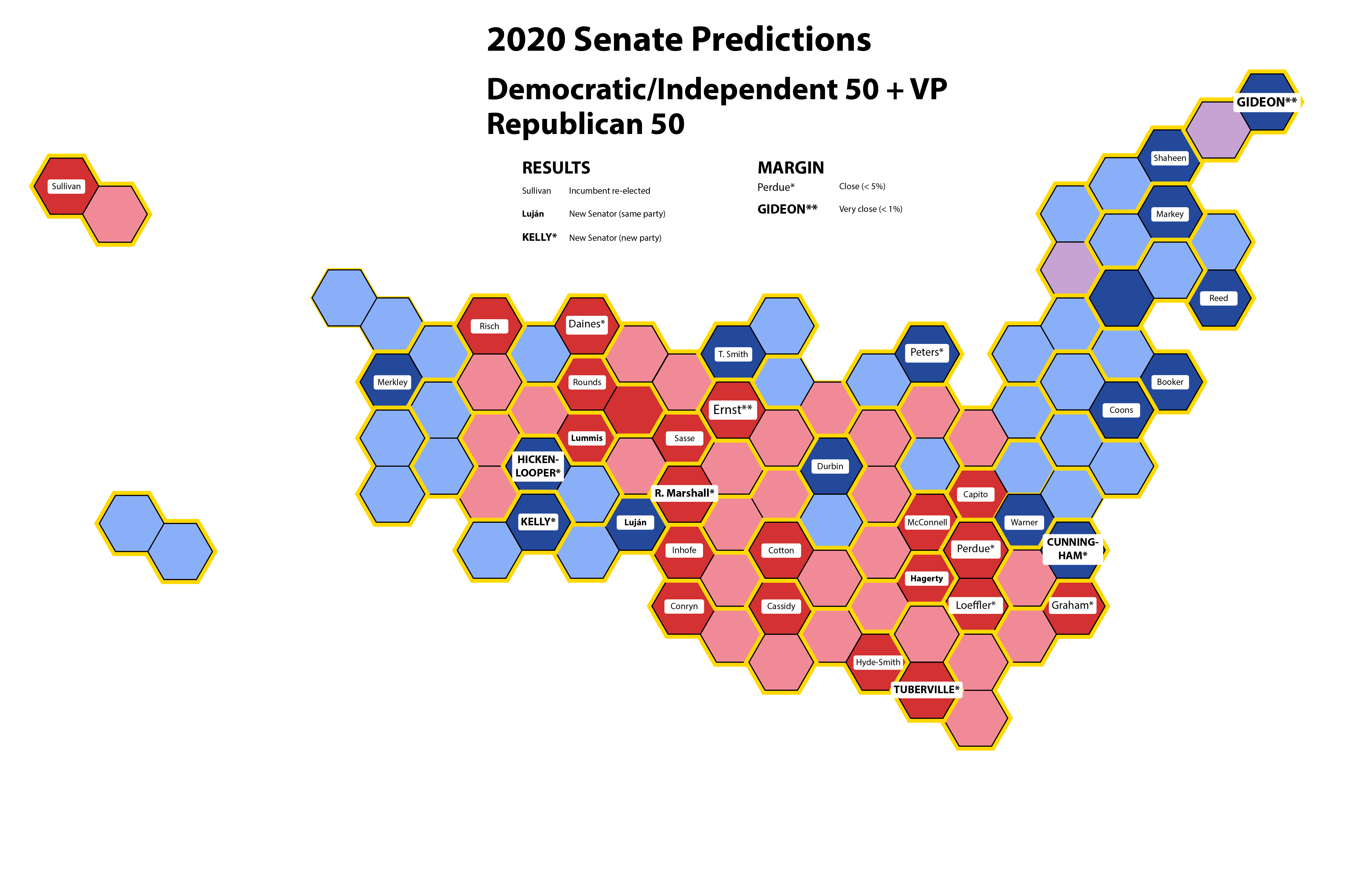
So far I’ve brought you several forecasts of the 2020 U.S. Presidential election (the most recent), and a forecast for the nail-bitingly-close Senate election, which I predict will messily resolve into the thinnest possible margin for a Democratic majority. Now the House elections, which I predict will result in a slight Democratic gain.
This was originally going to be a single post, then a 3-part series. So, welcome to my 4-part series of 2020 House election predictions!
Today, previews of close races – those where I predict the vote will finish within 5 percentage points – in the alphabetical first half of states, from Alaska to Minnesota, then skipping over the “New” states directly to North Carolina because apparently I cannot into alphabet.
The National Map
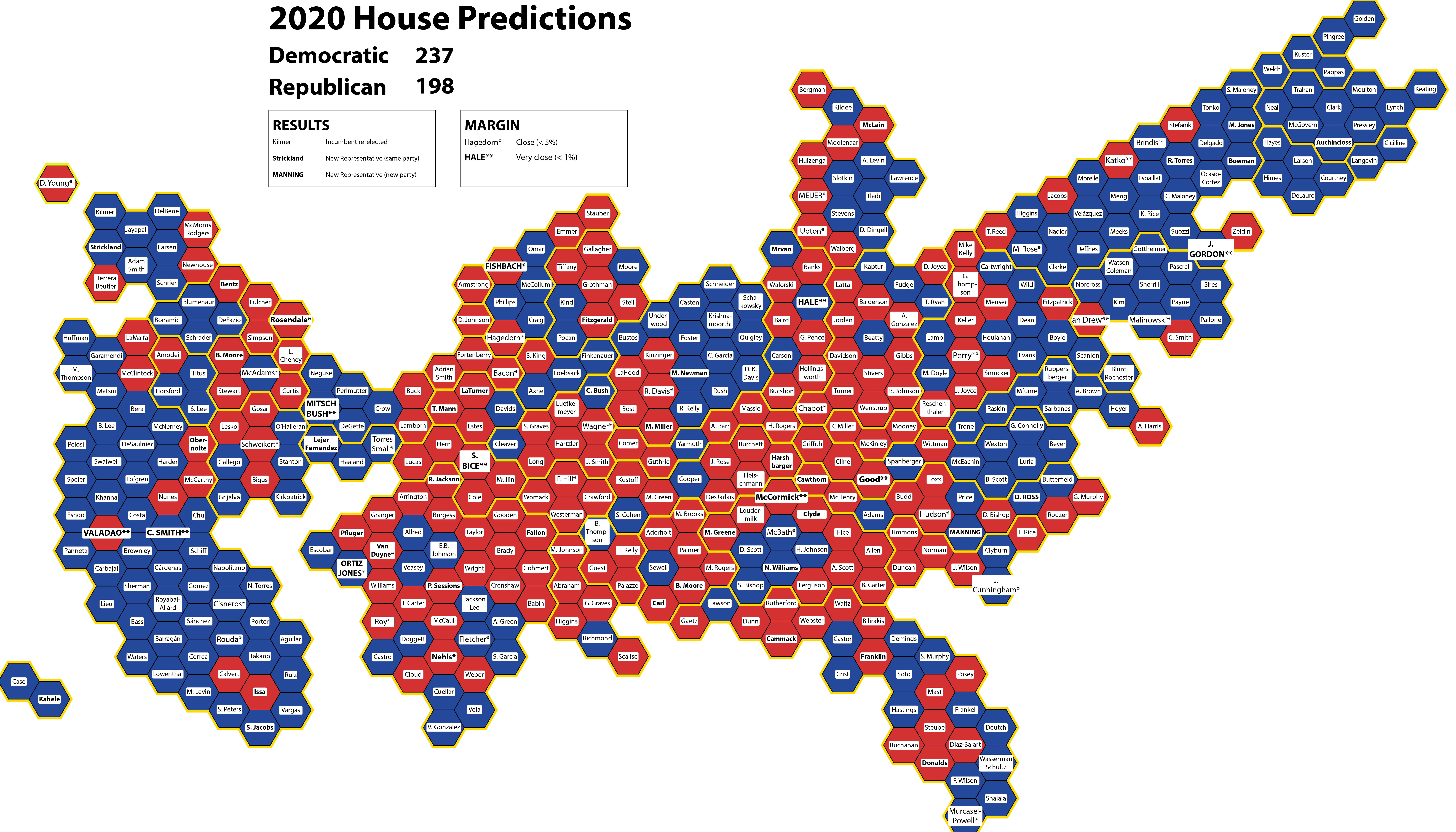
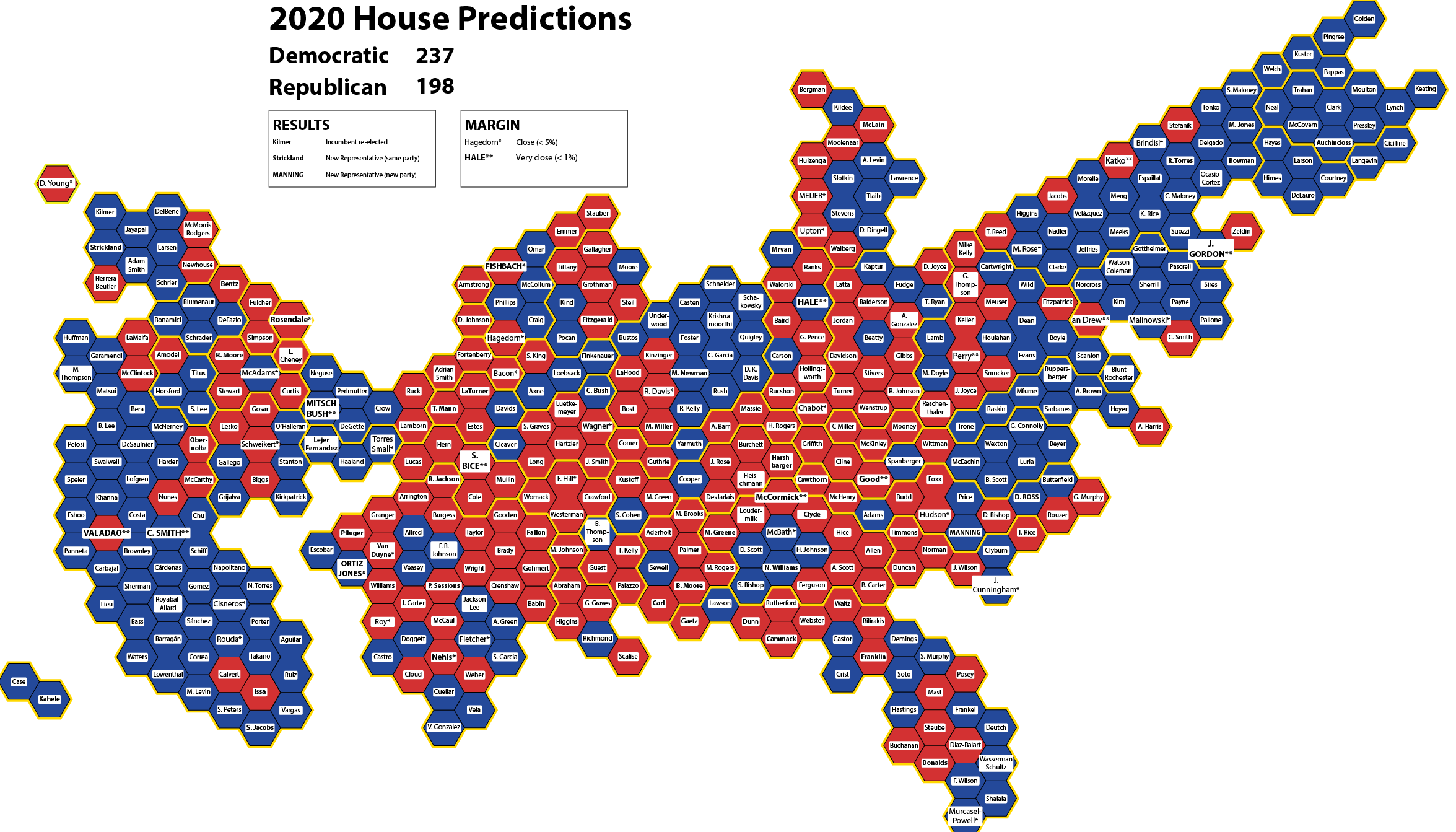
Below is my forecast map for what the entire House will look like when the 117th U.S. Congress opens on January 3, 2021 (for comparison, here’s what the map looks like now). See the guide below for what each part of the figure means, and definitely click on it for a version you can actually read.
How to read the map (skip if you know it already)
As is traditional yet completely arbitrary, Republican representatives are shown by red hexagons and Democratic representatives are shown by blue hexagons. The text labels show the names of the incoming representative; plain text means that I predict the incumbent will be re-elected, bold means that I predict a new representative will be elected from the same party, and bold all-caps means that I predict a party switch. A larger font size and a single asterisk(*) mean the election is likely to be close, within about 5%. An even larger font size and double asterisk(**) mean the election is likely to be very close, maybe within 2%.
Preview of close races (New Jersey to Texas)
In my Senate prediction, I offered at least a passing comment on each of the 35 races. With 435 House races, I’m obviously not going to do that, but I have looked at them all to get a sense of which will be most exciting.
Here they are, starting with the close races marked with a single asterisk (*) in the map above.
House races likely to vote within 5 percent (52%-47% or closer)
New Jersey 7
This district covers several of the rural and exurban communities of northwestern New Jersey. With a median household income of $104,000 per year, it is the richest congressional district on the close races list, and fifth-richest in the country. In 2018, Democratic challenger Tom Mailnowski upset five-term Congressman Leonard Lance. He is running for re-election against State Senator Tom Kean. There have been no polls in this district since March 11th, when dinosaurs roamed the Earth. So who knows. But incumbent + slight Democratic lean to the district + probably a good year for the Democratic Party overall =
Prediction: Malinowski re-elected
New Mexico 2
New Mexico, like the Mongols, is the exception. It’s a western state, mostly rural, with only one metro that feels like it’s bigger than it really is – the Albuquerque metro area has a smaller population than those of Fresno, California or Greenville, South Carolina. And yet, because of its significant Mexican-American and Native American populations, it tends to vote Democratic in national elections, enough that it has moved completely out of swing state territory.
New Mexico’s second district encompasses the southern half of the state, plus a gerrymandered tentacle (gerrycle?) reaching up to crack Kirkland Air Force base in half.
In 2018, longtime Republican representative Steve Pearce (not that one) stepped down to run unsuccessfully for Governor or New Mexico, and Democratic candidate Xochtil (pronounced SHOCK-til) Torres Small won an extremely close election against Republican Yvette Herrell – so close that it appeared Herrell had won on election night, but Torres Small pulled ahead once all the votes were counted. The same two face off again this time, with Torres Small as the incumbent. Polling is once again extremely tight, with Torres Small leading by 3 in the average.
Prediction: Torres Small re-elected.
New York 11
New York has 27 House districts, 10 of which are entirely within New York City. One of those is the 11th, which includes all of Staten Island and some neighborhoods at the southern tip of Brooklyn; it is the only district in New York City that voted majority for Trump in 2016 (at 53%). It is currently represented for the Democratic Party by Max Rose. He is running for re-election against state assemblywoman Nicole Malliotakis. Rose is ahead by 5 points in aggregate voting and is likely to win.
Prediction: Rose re-elected.
New York 22
This district runs north-south through the bridge of New York’s nose, between the Adirondacks and Lake Ontario. It includes the cities of Ithaca, Binghamton, Newburgh, and Poughkeepsie. In 2018, Anthony Brindisi won the seat back for the Democratic Party by defeating then-incumbent Republican Claudia Tenney. The same two face off again this time, with Brindisi 4 points ahead in aggregate polling.
Prediction: Brindisi re-elected.
Ohio 1
Ohio-1 is another gerrymanderiffic district looking like a pair of sexy nunchucks to crack apart Cincinnati. It has been represented by Republican Steve Chabot in 12 of the last 13 Congresses, missing only on term after losing in the blue wave of 2008 but getting voted back in in 2010. His opponent is Cincinnati public health worker Kate Schroeder. The race is tightening, but Chabot is up by 2.5 percentage points with two weeks left.
Prediction: Chabot re-elected.
South Carolina 1
This is another gerrymanderific district, centered on the city of Charleston, South Carolina. It includes the southern half of South Carolina’s coastline, plus one of those beefy arms for good measure. The district typically votes Republican in the Presidential election, by double-digit margins. But in 2018, the district elected its first Democratic representative by less than 4,000 votes. That representative is Joe Cunningham, and he is running for re-election for the first time against state representative Nancy Mace. Normally it would be an uphill battle for Cunningham in such a solidly Republican district, but Mace’s popularity is fading along with Trump’s, and Cunningham is now up by 3 in aggregate polling.
Prediction: Cunningham re-elected
Texas 7
In the 2020 House elections, the eyes of the world are on Texas. The first of five close races we’ll look at is Texas’s 7th congressional district, which covers the western suburbs of Houston. Democratic incumbent Lizzie Fletcher is running for re-election against real estate agent and former Army helicopter pilot Wesley Hunt. Fletcher led by 4 when I made the map, but her lead has extended to 5 since.
Prediction: Fletcher re-elected
Texas 21
I don’t even know how to describe the shape of this gerrymandered district. Evil Massachusetts? A snuffleupagus with a goatee smoking a pipe? Regardless, it exists for only one reason: to crack the cities of Austin and San Antonio by shoving as many of their voters as possible into a weird district, while also including enough rural area to the west so that rural voters will maintain a slight edge in numbers.
But I digress.
In 2018, 16-term Republican incumbent Lamar Smith retired, and Republican Chip Roy won the seat. His opponent this time is a hero of the Texas Democratic Party: Wendy Davis, whose 13-hour filibuster succeeded in stopping passage of a restrictive abortion bill (although it passed in the next legislative session). Roy is ahead by just under 4 points in aggregate polling.
Prediction: Roy re-elected
Texas 22
Here’s another weirdly gerrymandered district, covering the southern suburbs of Houston. Painfully asymmetric breasts?
Six-term incumbent Republican Pete Olson is retiring, opening the seat to a new occupant. The new occupant will be either Fort Bend County Sheriff Troy Nehls or foreign service officer and national security expert Sri Preston Kulkarini. The candidates’ signature issue issues are law enforcement and health care. Guess which is which!
The race is tightening, but aggregate polling has Nehls 3 points ahead.
Prediction: Nehls wins, holding the seat for the Republican Party
Texas 23
This district covers a vast rural area of western Texas, from the outskirts of San Antonio to the outskirts of El Paso. It takes 8 hours to drive from one end of the district to the other. The district is majority Mexican-American, but the inclusion of the highly conservative San Antonio suburbs, plus the cities of Midland and Odessa, makes for a hotly contested district. It is currently represented by Will Hurd, of the most moderate and bipartisan-willing Republicans in Congress. Presumably sick of the bullshit, Hurd surprised many by announcing he would not seek re-election, issuing what may be the most politely shade-throwing retirement statement of all time:
I’m leaving the House of Representatives to help our country in a different way… It was never my intention to stay in Congress forever, but I will stay involved in politics to grow a Republican Party that looks like America.
Soon-to-be-former Rep. Will Hurd (R-TX-23)
I like this guy.
His replacement will be either his 2018 opponent, Air Force veteran and national security consultant Gina Ortiz Jones, or conservative populist Navy veteran Tony Gonzales. Ortiz Jones is ahead by 5 points in polling.
Prediction: Ortiz Jones is elected, switching the seat to the Democratic Party. And also becoming the first openly LGBT person elected to Congress from a southern state.
Party Switches
If you’re keeping score at home, we’ve had three party switches after the review of close races, with a net gain of +1 for the Republicans:
MI-3: Justin Amash (L) -> Peter Meijer (R)
MN-7: Collin Peterson (D) -> Michelle Fishbach (R)
TX-23: Will Hurd (R) -> Gina Ortiz Jones (D)
But if you remember my overall prediction from the map, it was +5 Democratic. So where will the Democratic Party get those extra six seats from?
Tune in Friday for the epic conclusion, the House races that I think could be decided by 2 points or fewer!