Continuing our gerrymandering series after a long layoff, with another state with two Congressional Districts:
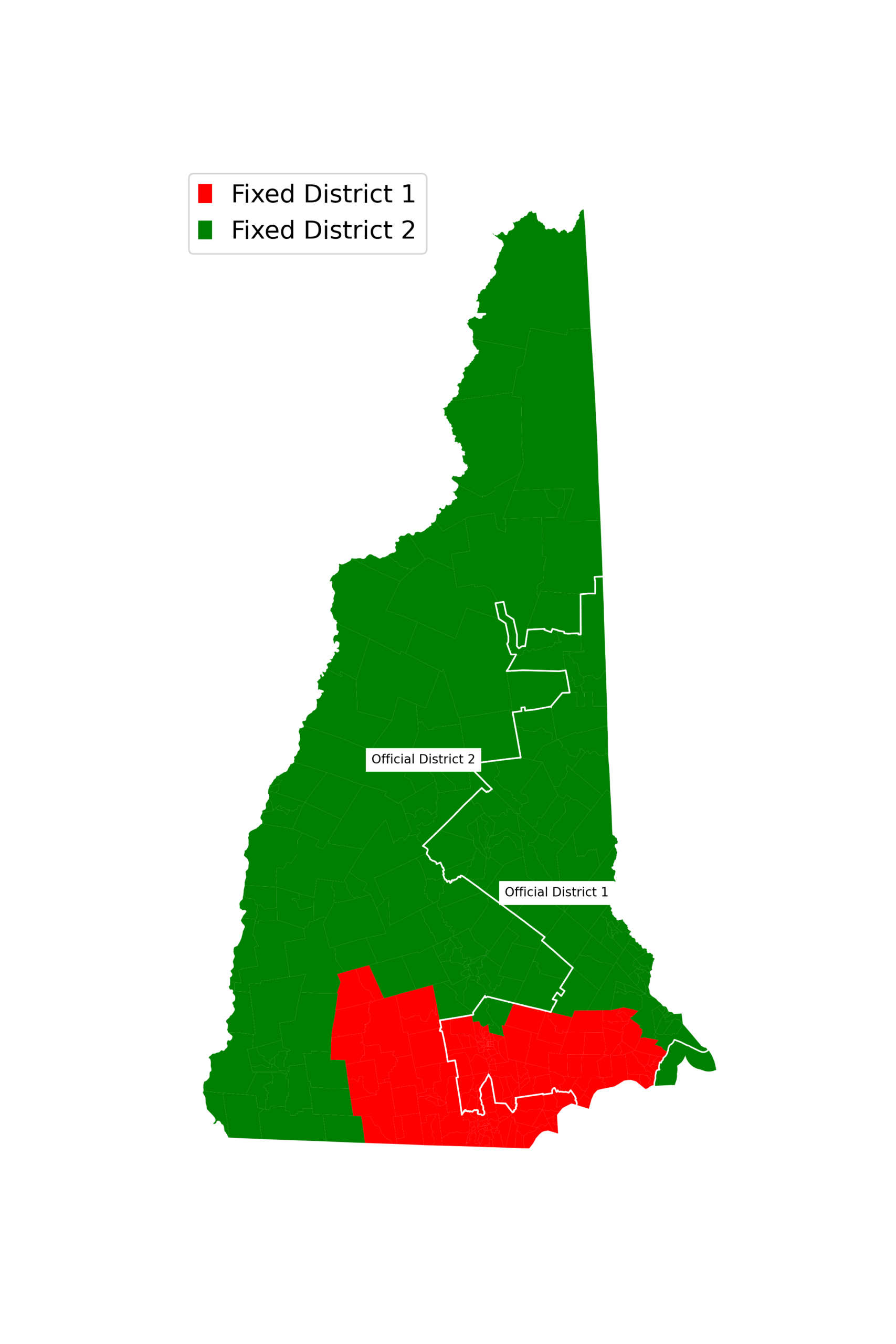
Suggested new Congressional Districts for New Hampshire (red and green), along with the boundary between the official new districts (white)
Most of New Hampshire’s population is concentrated in the southern part of the state, so it makes sense that one fair district would include the south and one would include the rest of the state.
Continuing our gerrymandering series: Almost Heaven…
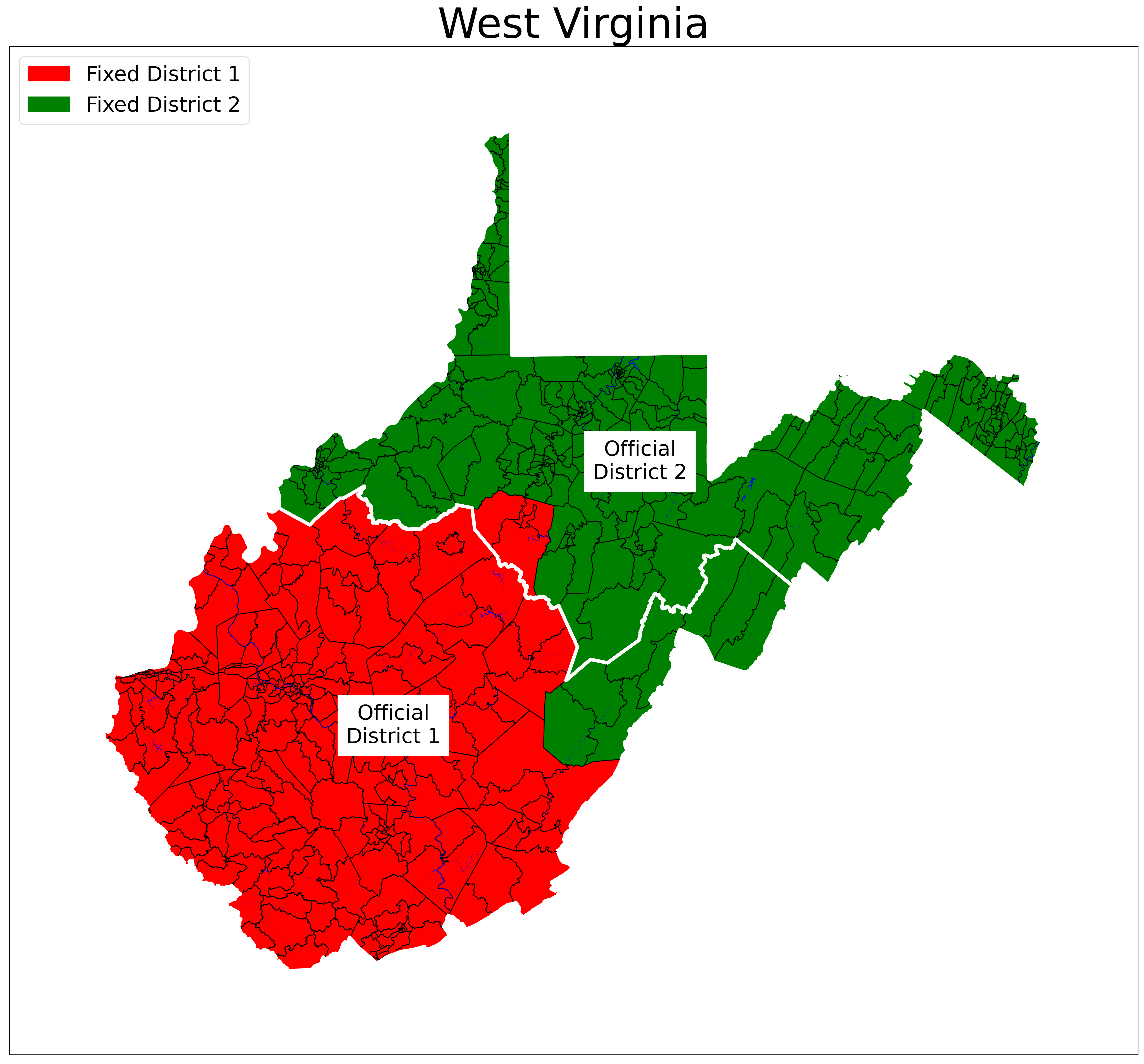
Suggested new Congressional Districts for West Virginia (red and green), along with the boundary between the official new districts (white). Click for a larger view.
Usual deal with this map: my fixed districts are shown by color: red for District 1 and green for District 2. The white line shows the boundary between the state’s two districts, adopted by the state legislature and signed into law by Republican governor Jim Justice.
Last week, we met the first state in my list to gain a representative in the House: Montana. Today, we meet the first state to lose a representative. West Virginia lost population between 2010 and 2020 – nearly 60,000 people, mostly from moving to other states – and so the state goes from three Congressional districts to two.
There’s not much to say about the strategy for redistricting one of only four states where the majority of the population lives in rural areas. Although Jefferson County at the tip of the Eastern Panhandle is part of the Washington, DC metropolitan statistical area (MSA), the largest MSA mostly within West Virginia is Huntington (+Ashland, Ohio), which ranks 150th in the country; the MSA containing the state capital of Charleston ranks 190th.
Huntington and Charleston both end up in District 1, both by my accounting and by the officially legislated districts. Either way, the district border splits the state in half, north and south. Like the entire state, both districts are heavily Republican, and will produce little drama in the general election this November.
What will be interesting is that the loss of a district means that two sitting representatives – David McKinley (R-WV-1) and Alex Mooney (R-WV-2) must now run against each other in the Republican primary in the northern district. Mooney is a darling of former President Trump, which would seem to make him the favorite, but because of the way the lines got drawn, most of the new district overlaps with the old district that McKinley represented, where is quite popular. So who knows. We’ll find out when the primary happens on Tuesday May 10, 2022.
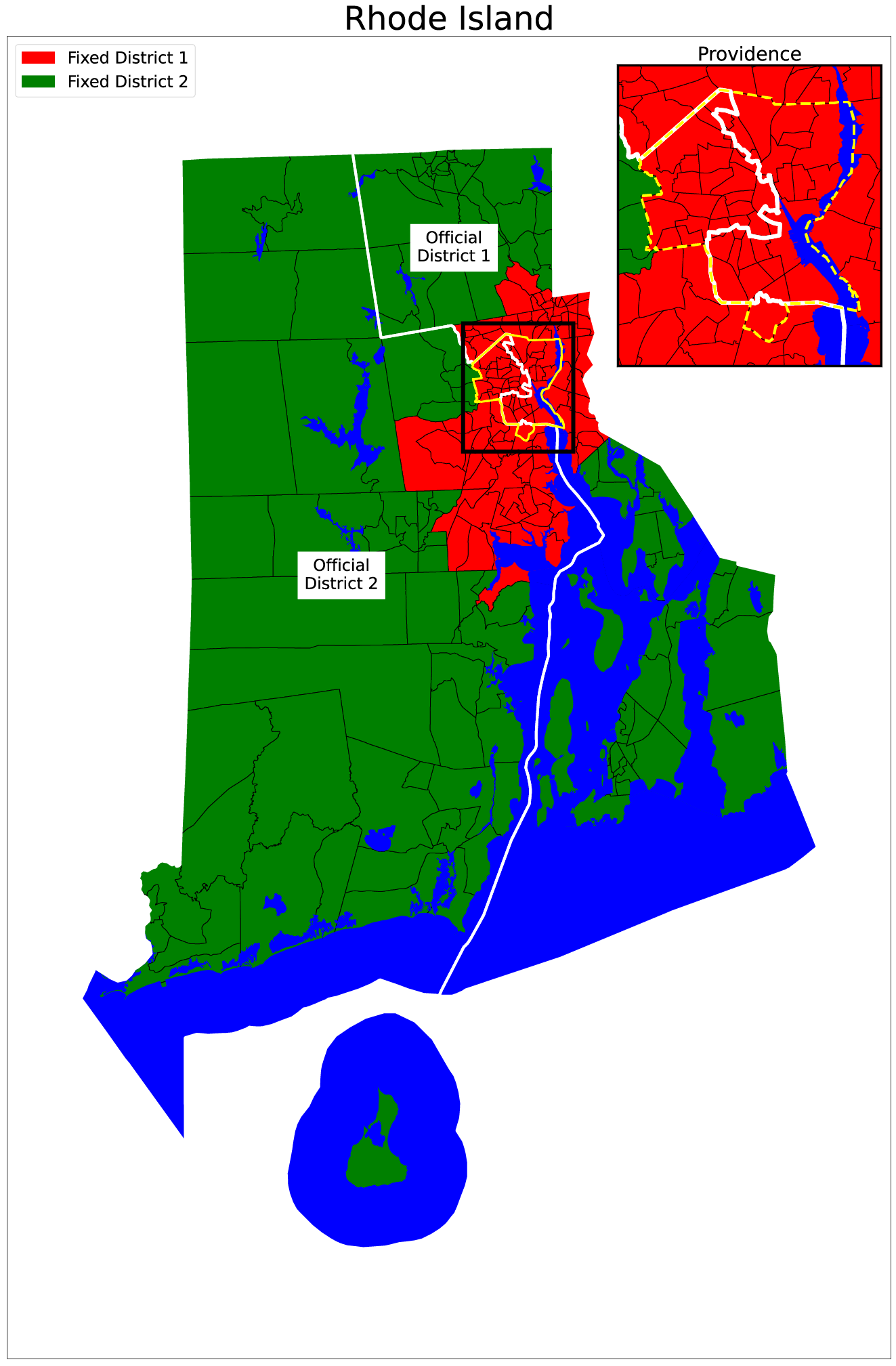
Suggested (colors) and official (white line boundary) new Congressional Districts for Rhode Island. The black box shows the area of the inset around Providence; the yellow line shows the boundary of the city of Providence. Blue areas are water. Click on the image for a larger version.
Why would you have the boundary between your two Congressional districts run right down the middle of the largest city in your state? Ask the Rhode Island state legislature, which approved this new redistricting plan on February 17, 2022. The new districts are nearly identical to the districts used for the last five House elections.
In the map above, notice how the boundary between District 1 (to the right of the white line) and District 2 (to the left) aggressively jumps to the east to split the city of Providence – Rhode Island’s largest city, containing about 20 percent of the population of the state. That jump is even clearer in the inset map of Providence in the top right; compare the district boundary (white) to the city boundary (yellow).
Compare that weirdness with my plan for redistricting Rhode Island. Remember the rules: beginning in the middle of the largest metro area in the state, I start assigning census tracts to a district until that district has accounted for the target population I am looking for: the total population of the state divided by the number of districts. So for Rhode Island, I started in Providence and worked my way out until I had 549,802 people in the district.
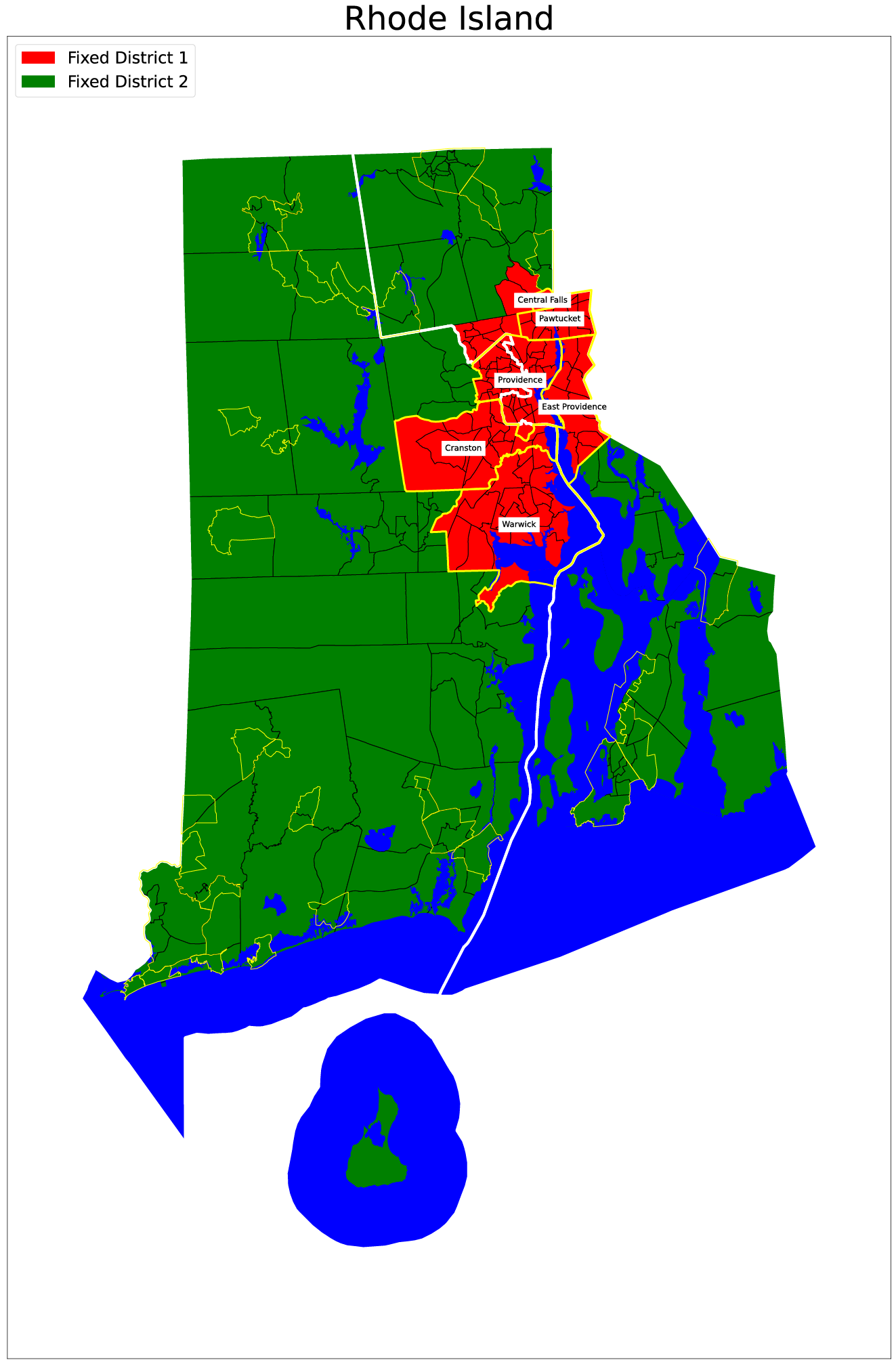
The result was that the entirety of the cities of Providence, East Providence, Pawtucket, Warwick, Cranston, and Central Falls are in my District 1, along with several tracts outside of any city just to the north of Providence. This map shows how my fixed districts line up with city borders:
Cities in Fixed District 1 (yellow outlines, with city names labeled)
In all the states I have fixed – and I have far more than I have shown so far – I have tried to keep cities together in the same district, and I have succeeded nearly every time.
With Rhode Island fixed, it’s now nine down, forty-one to go.
The bigger the states get, the more fun the ungerrymandering gets. Stay tuned!
Continuing our gerrymandering series with the the sideboob of the Rockies, the state that’s all up in Idaho’s personal space:
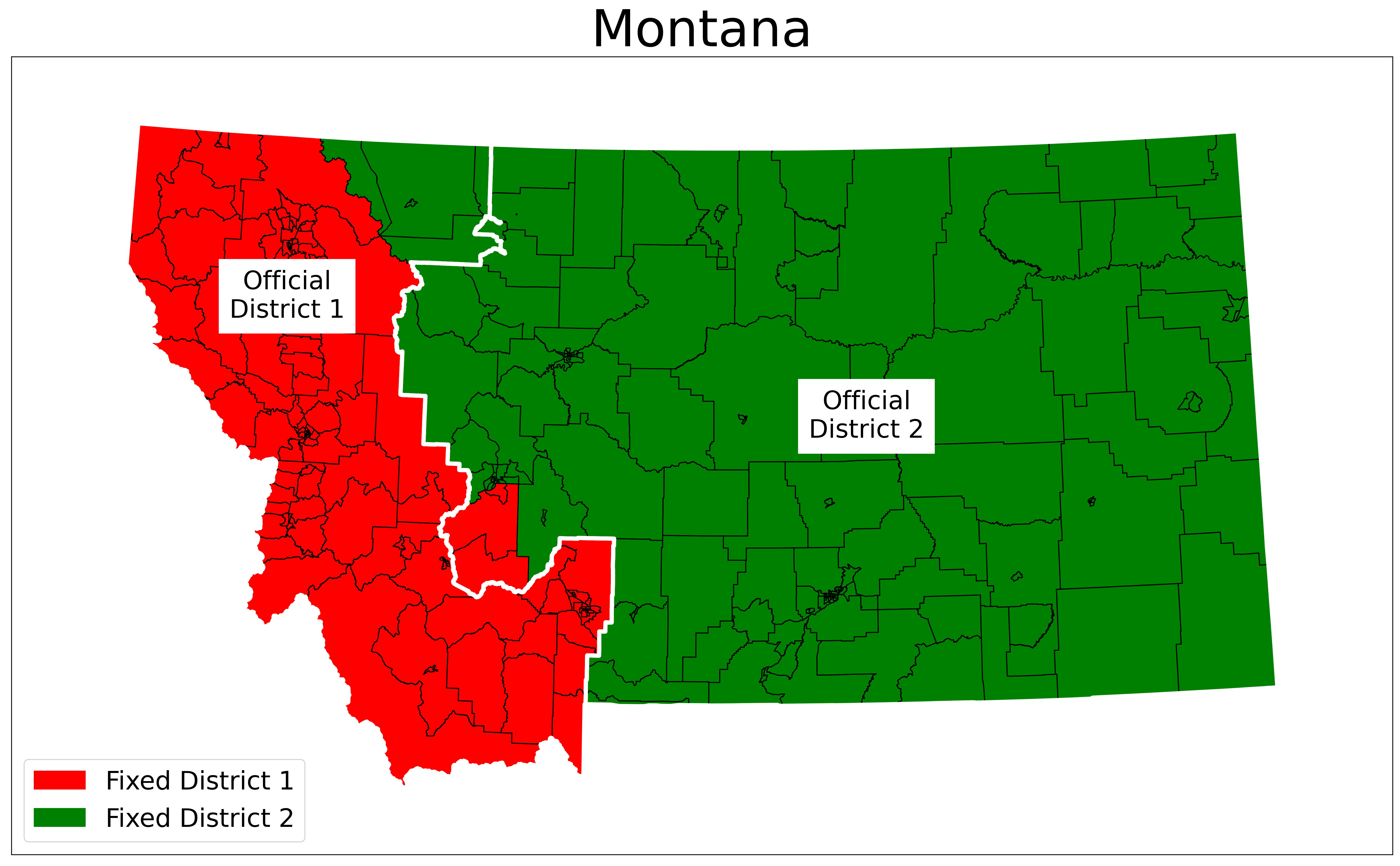
Suggested new Congressional Districts for Montana (red and green), along with the boundary between the official new districts (white). Click for a larger view.
Montana has major reason to celebrate this year. For the past 30 years, they have had only a single representative in the U.S. House, currently Republican Matt Rosendale. Their population has increased enough that they now get a second.
Two Congressional districts means they have to draw them on a map, and mapping districts means the potential for gerrymandering. And the potential for gerrymandering means the potential for me to do it better.
Except I don’t think I did this time. Montana was the easiest state for my arranging of proposed districts; I was able to do it all at the county level. I divided Montana into a western District 1 (red) and an eastern District 2 (green). About 60 percent of the way down the boundary, my District 1 juts to the left, just south of Montana’s capital city of Helena. Helena, and all of Lewis and Clark County, is in District 2 – but Jefferson County immediately to the south is in District 1.
Montana, like Idaho, has a bipartisan independent redistricting committee. Their results are shown with the white dividing line in the image above, with District 1 on the left and District 2 on the right. Notice how their line gives much more space around Helena – I think they did a better job drawing districts than I did.
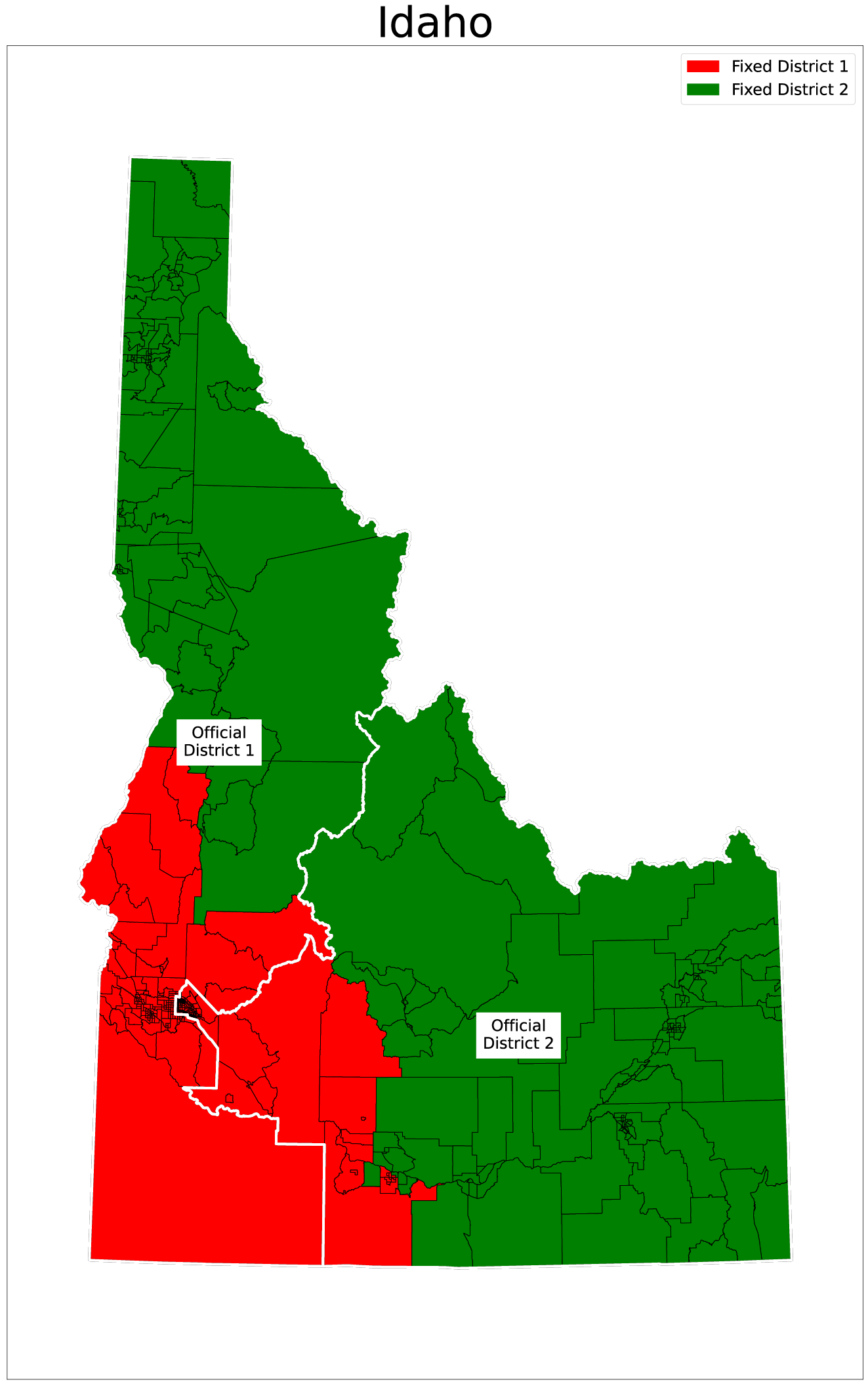
Suggested new Congressional Districts for Idaho (red and green), along with the boundary between the official new districts (white). Click for a larger view.
Idaho has two House districts to plan. The map above shows both the districts I came up with (red is District 1 and green is District 2). The white line shows the boundary between the new districts that were approved by Idaho’s independent, bipartisan redistricting commission in a public meeting on November 5th, 2021.
I made my “there I fixed it” map without consulting the official new districts set by the redistricting commission, because I wanted to get a fresh and independent look at the solving the problem of dividing up the state into reasonable electoral districts. My approach, as I outlined on Monday, is to start with the largest metropolitan area in the state and move out until I fill up one district. In the case of a state like Idaho that has only two districts, that’s all I need to do: filling up one district will automatically set the other, which will include all census tracts not selected.
There is only one reasonably large metropolitan area in Idaho: Boise. The 2010 Idaho Congressional Districts map annoyingly split the city of Boise, so I wanted to make sure to keep the Boise metropolitan area as part of the same district. I kept it all in District 1. I ended up having to put the dividing line across the Twin Falls metropolitan area – and indeed, the city of Twin Falls (Idaho’s eighth-largest city). But I managed to put most of Twin Falls into District 1, with only the northeastern edge in District 2.
What about the actual map that will be used for Idaho’s House elections from 2022 to 2032? It’s not too bad. It’s actually a big improvement over the 2010 edition, which split the city of Boise. The new map features almost all of Boise in District 2, except for a small area in the southwest in District 1.
Montana is creepy
So that’s one more state ungerrymandered. Including Idaho with the six one-district states means that we are now at seven down, forty-three to go.